
 Lindon Edward Wooster
This free script provided by JavaScript Kit
© The Wooster Family Group
Lindon Edward Wooster Tree By Julian WoosterA twenty two year old, male only child, privately educated and with a sizeable inheritance burning a hole in his back pocket sounds like a recipe for disaster and self-destruction; Lindon did not disappoint. My grandfather thought of his father as a hero of the Great War; even though he was just a toddler when he died in 1917, his mother barely spoke about him and there were no reminders of him at home. Apparently his mother had told my grandfather that she had been so upset by his death that she had destroyed all his possessions. This always appeared strange to me when my grandfather recounted it to me as a teenager.
It's natural to think of a soldier who has died during conflict as a war hero; especially when they have a military grave in a foreign land. The truth however, as we shall see is much more nuanced. Lindon Edward Wooster (my great grandfather) was born in Bristol in 1891 to Clement and Milicent Wooster. Clement was originally from London and rose to become the chief accountant of the Bristol United Brewery. Milicent was the daughter of a gentleman farmer from Worcestershire. Lindon was an only child, born when Milicent was 41. He had a privileged life, attending Clifton College the premier fee paying school in the city. When Clement died in 1910 at the age of 57, he left Millicent in his will £17756 (£1.75m in today's money). 3 years later Milicent died and left her son £11213 (£1.1m in today's money). 
Above: Lindon's gravestone at Dunhallow Cemetery in Belgium
It seems that my grandfather had never really questioned this narrative and out of respect for him, neither did I. Not to his face at least, but as I became older and thought more about my family history, it increasingly didn't make any sense to me. My grandfather knew that his father had inherited a lot of money and been involved with cars at the start of the war - there were photographs that alluded to that, but he was un-sure what had happened to all the money. He did know however that his mother had struggled for money once her husband had died, had difficulty getting a war widow's pension and relied on the kindness of her family for support (mostly her mother and sister). The family were not on the bread line, but the luxuries she had been accustomed to as a married woman had to go, including the nanny.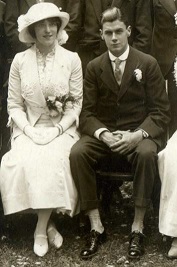
Left: Wedding day. Right: With Constance and twin sons Gordon & Denys (my Grandfather)
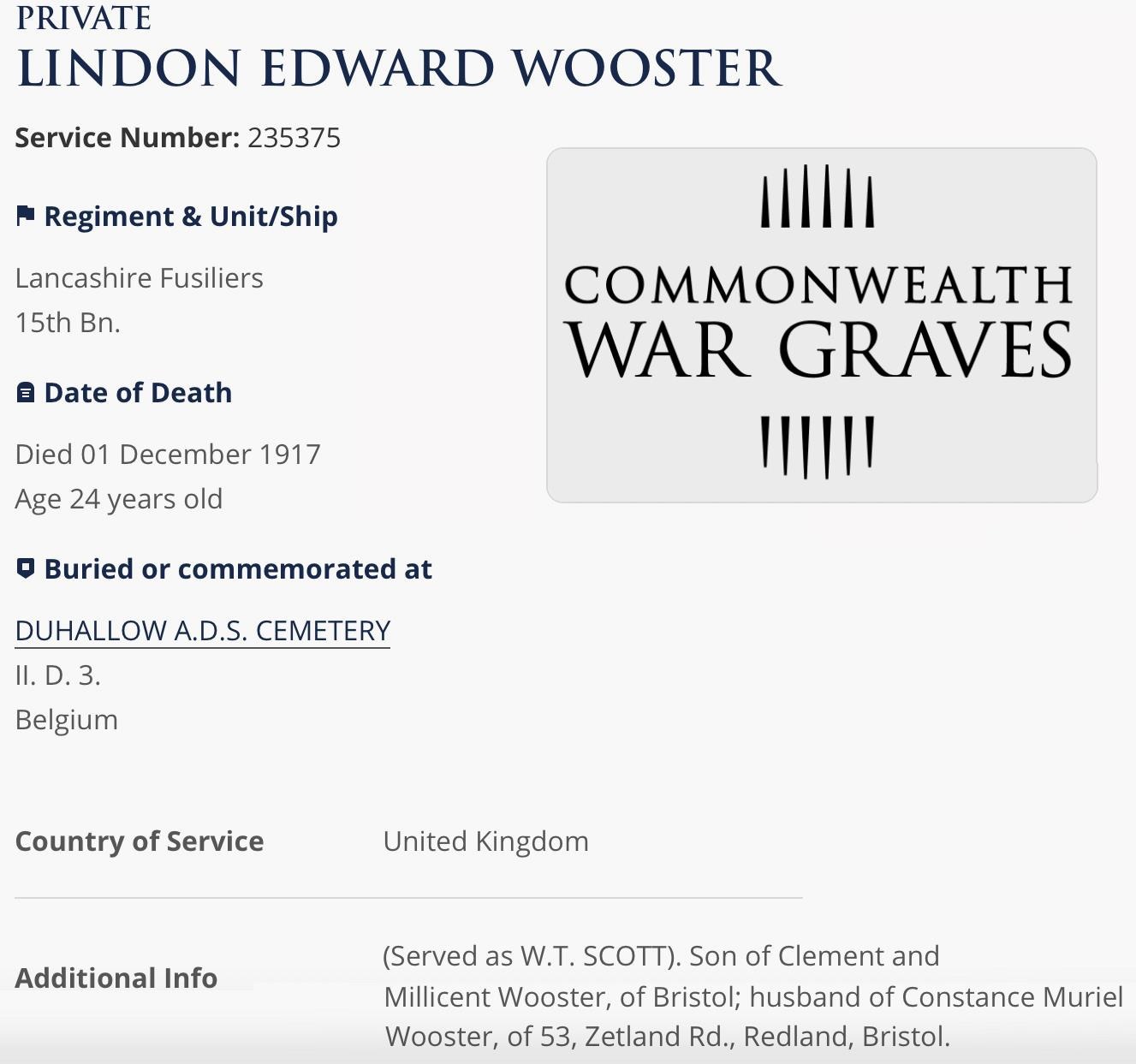
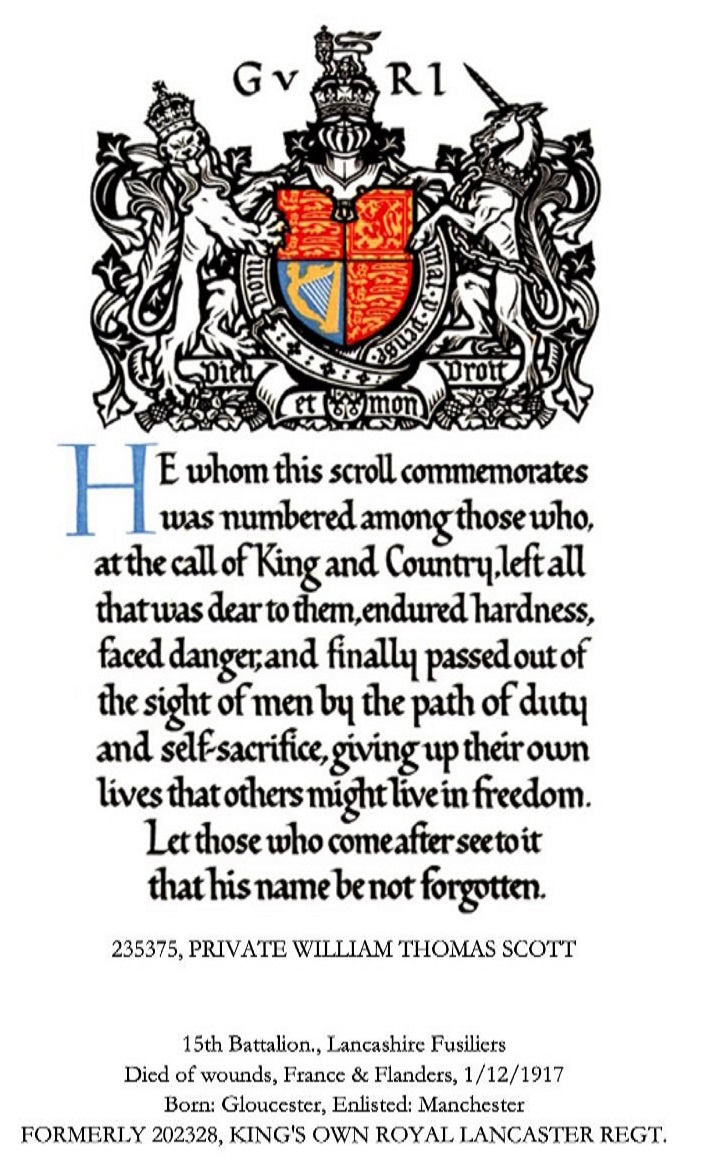
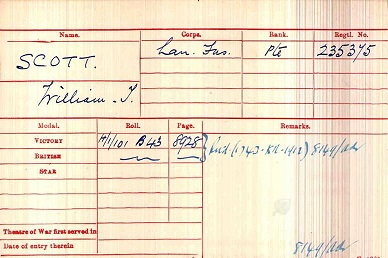
After visiting his grave in Ypres in the 1980's my father and I discussed what we knew about him on the way home. I couldn't understand why a rich man from Bristol with connections to London had joined a Lancashire regiment (2 regiments, as it turned out) and as a Private? He surely had enough money and connections to obtain a commission or avoid enlisting at all? My father had also noticed that the age of death on the grave stone was out by 2 years and his name was inscribed in full, when most other were initials and surname.. All together, none of it added up. There was something going on, but no evidence in the family to say exactly what. It felt to me that he had joined the army to escape from something or someone and the money was probably at the root of it. By the time I had actively begun looking into my family history (~2008), the internet was becoming an essential tool for research. Although LE Wooster's war records had been destroyed during WWII bombing in 1940 and there was therefore no way to find where and when he joined up. The online databases of the Commonwealth War Graves Commission (CWGC) and National Archives (PRO) provided break throughs into what may have happened. The CWGC website stated that although his name was Lindon Edward Wooster, he served under the name WT Scott (William Thomas Scott) - a fabricated alias. The National Archives website identified document PRO J14/914 from 1915; a winding up order for the Ritz Motor Company with Lindon Edward Wooster as the plaintiff.Lindon Edward Wooster at the wheel of an impressive vehicle
Source: Uxbridge Advertiser, 2nd April 1915
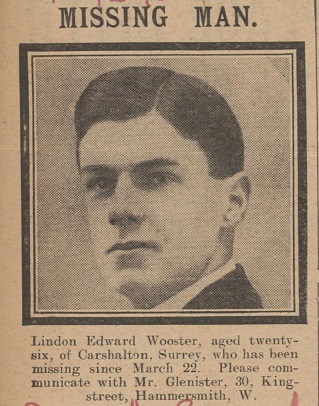
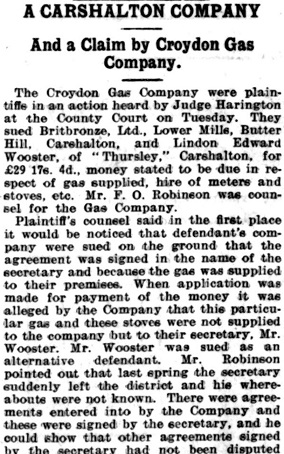
Above left: Reported missing (Daily Mirror, March 1917). Right: Sued by Croydon Gas Company (Croydon Times, October 1917) However there is still much more to know, most of which will never be revealed. In the mean-time before everyone's imagination runs away with itself, let's stick to the facts and chronology as we understand it at the present time. 12th June 1891 - Born in Bristol April 1906 - Left school (Clifton College) 27th January 1910 - Father dies in Bristol. Leaves £17756 to wife Millicent (£1.75m in today's money) 2nd April 1911 - Living with mother in Bristol, working as a Clerk (1911 census) 12th June 1913 - Marries Constance Parry in Bristol (on his 22nd birthday) 2nd July 1913 - Mother dies in Bournemouth. 1st August 1913 - Inherits £11,213 (£1.1m in today's money) 31st May 1914 - Twin sons (Gordon & Denys (my Grandfather)) born in London 2nd April 1915 - Issued speeding ticket in Pinner January-July 1915 - Plaintiff, Wooster v Ritz Motor Company. High Court of Justice, Company Winding Up Order, National Archives J14/914 22nd March 1917 - Reported missing in the Daily Mirror 20th October 1917 - Sued by Croydon Gas Company 1st December 1917 - Died in Ypres, Belgium. Buried in Dunhalllow ADS. Served under the name of William Thomas Scott (235375, 15th Battalion Lancashire Fusiliers) If anyone has any other insights or thoughts I would be grateful to hear them. Was my great grandfather a war hero or a cad and a bounder; a victim of circumstance or just young and foolish? I expect he was all of the above. I would love to know who his associates were and what his plan was if he had survived the war. There is more work to be done with the evidence available; following up about the war pension and the court cases for example (can any of you read legal documents?). My great aunt who on occasion must have spoken with her mother-in-law about by great grandfather indicated that the marriage would have ended prematurely anyway. No specific reason was given, but it makes me think there is much more to know. I guess there always is..
Page last updated
26 May 2026