
 Military Section
This free script provided by JavaScript Kit
Herbert HeyBirth: 1891, Colne, Lancashire, England
Death: 1970, Te Awamutu, New Zealand Tree
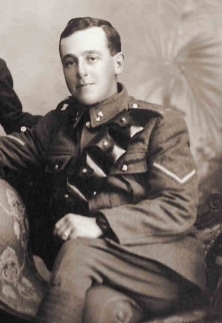
Service: WW1 (10th Nov 1917 to 11th Nov 1918):
2nd Battle of Passchendaele, Retreat from Messines, Battles of Lys,
3rd Somme and Le Quesnoy
Rank: Driver, 6th Battery, 2nd Brigade, New Zealand Field Artillery
Enlistment Date: 27th November 1916
Embarkation: 26th April 1917, SS Turakina from Wellington
Discharge: September 1919
Herbert and His War
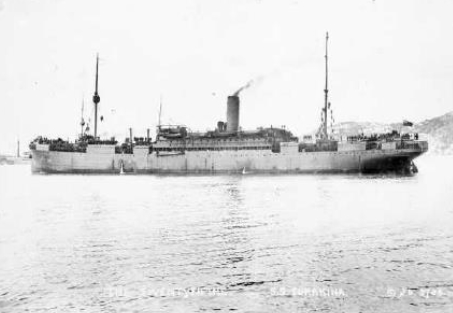
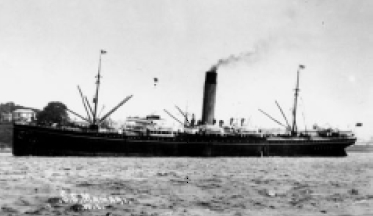
Troop Ship SS Turakina
In November 1916 Herbert Hey went to Hamilton on the 27th of the month to enlist. He volunteered for the Reinforcement Draft and nominated January 1917 to sign in[1]. Herbert, nearly 26 years of age was not a tall man, only 5'3" and of slight build. He had an injury to his hip as a lad and now walked with a limp which meant the muscles in his leg were not so strong, but he could ride horses. Consequently it was recommended "that if possible be given work such as driver in artillery"[2].
After a few months in training Herbert finally embarked on the troop ship SS Turakina in Wellington on 26th April. His parents would have felt the dread that all parents, especially mothers, feel about their children going to war as he left them for France.
He arrived at Plymouth, England on 20th July 1917 and from thence to the East Lancashire Regiment's Camp at Chadderton near Oldham, Manchester. This land which had been a golf course until WW1 was requisitioned and taken over by the military authorities.
Now this would have been like a return home for Herbert and when he had leave from camp he took the opportunity to contact his Hey relations in Colne some 29 miles away [3].Marriage
He also took the opportunity to renew a friendship with a young woman whom he had met before he left for New Zealand when he was twenty years of age. Her name was Dorothy Pendlebury who was born in Cheshire, the second daughter of Edwin and Minnie (Mary) Pendlebury. Edwin was born in Leigh about six miles from Worsley where the Hey family lived before coming to New Zealand.
Like his father before him, Edwin Pendlebury's occupation was a mining engineer. The name Pendlebury occurs frequently in Lancashire and especially around Manchester where there is an area by that name not far from Worsley. It was during the 2½ months at Chadderton that Herbert and Dorothy, now 27 years old were married by license on 24th September at Ruthin, Wales. Her father Edwin Pendlebury and Captain Peter Hood acted as witnesses. According to a newspaper report this was a wonderful event and very romantic.
By now Herbert was posted to the NZ Field Artillery, initially as a gunner, but later, as a driver and by the 17th October he was on his way to France from Aldershot Camp, having to leave his new bride.On The Western Front
Once arrived in France his regiment marched to Etaples, the general depot, rail head and training camp in the north of France. It was also home to 16 hospitals – British, Australian and New Zealand – and a convalescent unit where soldiers came to recover from their wounds or stopped on their way back to Blighty.
What unit was he attached to?
Herbert was posted to the 6th (Howitzer) Battery of the 2nd [Army] Brigade NZ Field Artillery as a "driver" The main job as a driver was to tow the guns into position where ever there was fighting. Either 2 or 3 pairs of horses were required, and each pair had a mounted driver whose responsibility it was to care for the horses and keep the harness in good repair. During heavy fighting trying to keep your horses fed and watered was often very difficult for both men and horses. 1917 was a lethal period for both horses and mules. They bore the brunt of battle having to pull either guns or wagons of ammunition, food, injured soldiers.
Herbert would have had a hard time finding food for them and the poor horses would have been over worked as they pulled artillery from place to place through dreadful weather and conditions.
[1] Herbert was in the 25th Reinforcement. Source: His Overseas War Service Gratuity paper
[2] Source: War records
[3] Source: Correspondence from cousins
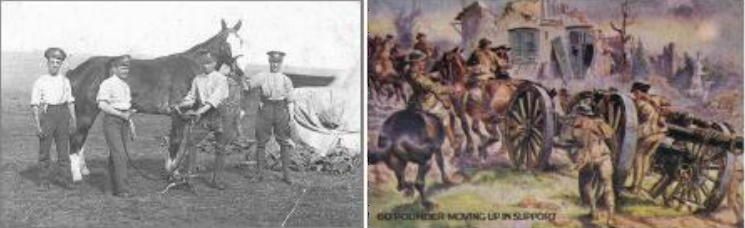
Left: Soldiers of the Royal Artillery prepare to trim the horse’s coats which was a controversial thing to do as it deprived the animals of the warmth
of a shaggy coat in the winter to keep them war. Right: Moving forward.
"The mud was awful and literally engulfed our horses" wrote one soldier. Another wrote: "many horses died of sheer fatigue". Apart from the guns from the opposing forces, disease and fatigue were the biggest enemies. If the horses could get back to the rear fir a time of rest in peaceful fields away from the mud they would soon pick up. Good veterinary care was also available and by the end of the war the British Forces were envied for their care and attention given to their horses.
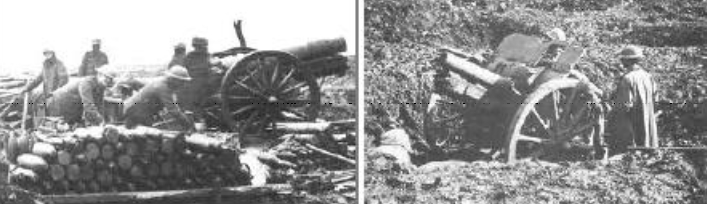
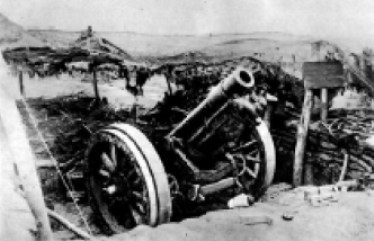
What were the guns he and horses towed?
6 gun and a 4.5 Howitzer in use in World War 1, Western Front
Where did his Battery serve?
Earlier in the year of 1917, before Herbert arrived in France, the brigade had undergone a reorganisation which was not unusual. “The 2nd Brigade was made an Army Brigade, and as such came directly under corps for all tactical purposes. The principle of the Army Brigade was that they constituted a mobile Artillery Force, which could be moved conveniently by corps from place to place in the line to strengthen the local artillery or to support operations pending or in progress. Army Brigades were subject to frequent moves, often at very short notice, and the 2nd Brigade was often detached from the Division after becoming an Army Brigade; the most extended absence being in the late autumn when the Division was in the Ypres salient. During this period of nearly four months the brigade occupied a sector on the coast near Nieuport.”
Therefore tracing the 2nd Brigade and the 6th Battery is a difficult task; however there are several mentions of it in the history of the New Zealand Field Artillery. They were not always with the other three batteries which made up the Brigade.
In June, three weeks after the Battle of Messines, the Brigade withdrew to the Belgium coast near Newport. The 2nd (Army) Brigade did not rejoin the NZ Division until the first days of December when they rejoined the 1st and 3rd Brigades in the Ypres Sector. In the intervening months before Herbert arrived, the German activity was particularly aggressive with heavy artillery. August, September and October saw continued heavy shelling. Herbert joined the ranks on 10th November. At the beginning of November the French began to relieve the NZ Brigade and by the 20th November they were marching south to join the rest of the NZ Division in the Ypres Sector.
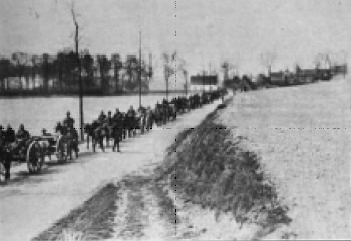
On Trek
They experienced bad weather on the march; quite a contrast to that which they had experienced on the coast. The conditions on the roads were extremely difficult due to the enormous amount of traffic- roads were narrowed and edged with deep ditches. Accommodation was scarce and inferior and the horses had to be held in open fields.[1]
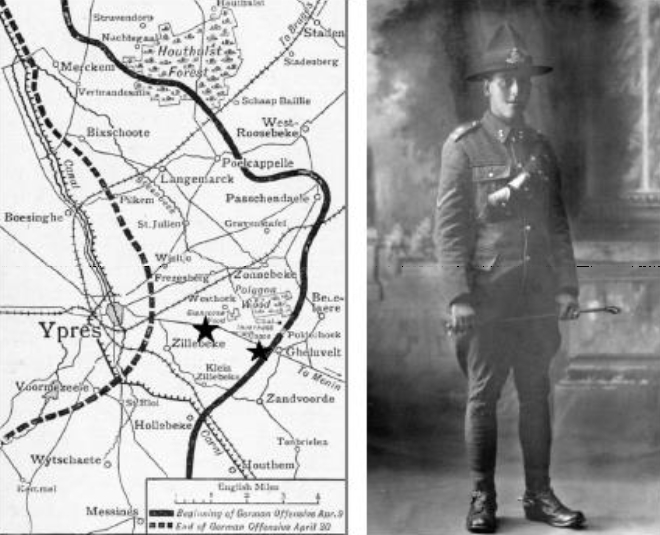
They arrived in the Ypres Sector near Polderhoek east of Ypres at the end of November and rejoined the NZ Division when they relieved the Australians. Wintering over in the Ypres Sector was stoically accepted. The wreckage and detritus of the previous battles lay all around- wagons, ambulance carts and craters; roads were all but impassable. The men of the 6th Howitzer Battery were situated near Glen Course Wood. (see map down)
Captured German blockhouses were used for battery headquarters and sleeping quarters, but like the gun emplacements they were in poor condition. Many of the gun positions were indescribable; the pits were water-logged with no entrances or decent platforms. They were littered about with empty charge cases and odd piles of ammunition which seemed on the point of sinking out of sight in the mud, but the soldiers got work. Draining and cleaning up, building weather-proof ammunition racks and stable platforms and splinter-proof sleeping shelters for the crews. Before the freezing weather came, improved shelter for the horses was required too. All this was done in the short daylight hours. By mid-winter most horses were under cover and a good many circular shelter huts were built for the men. Encouragement was given to every form of sport during the winter, especially rugby, a variety of amusements and entertainments were promoted to brighten the tedium of existence. Perhaps this was where Herbert may have used his talents as a performer and helped lighten the atmosphere amongst his fellow soldiers.
From the beginning of November the German troops were increasing in number in the sector and the British Forces were desperate to renew their defence system. This was all done under a continual barrage of enemy artillery as they continued to shell roads and battery positions.
Snow fell on Christmas Day and despite a flurry of activity early in the day, the day passed in peace. One imagines Herbert's thoughts turned to his new wife, Dorothy and to his family on the farm on the other side of the world. Conditions remained unchanged through January of 1918. Late in the month a derelict tank on German lines, used as a strong point, was taken pout by Herbert's 6th Battery with German casualties. Increasing harassing fire was employed by the Germans and gas shells were often used.
Towards the end of February the Brigade was relieved and retired to Westoutre to the Corp Rest area well to the west of Ypres, even though there was still enemy activity in the Ypres area. When the expected German offensive began on 22nd March, Herbert's Brigade was still in Westoutre. The first and Third Brigade were directed south to the Somme where the action was, but Herbert's brigade returned to the Ypres sector after a fortnight training and some rest and recreation expecting a quiet time. However, far from enduring routine duties at Ypres, they found themselves fighting a rear-guard action in the Lys Battle – an experience which befell no other brigade in the New Zealand Division.
[1] Source: NZ Artillery in the Field 1914-18 by Lieutenant J R Byrne (www.nzetc.org) Photograph p 192
April 1918 – note Glencourse Wood and retreat lines Herbert Hey
(Map by courtesy of www.1914-1918.net website)
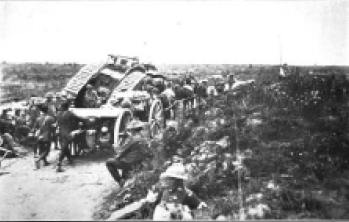
Herbert and his battery found themselves retreating in the face of enemy fire as the Germans pushed the troops back, losing much of the ground that they had taken in previous battles. On April 9th the battery found itself in danger of being surrounded as they worked their way back from their position in Ploegsteert Wood. The enemy was not far away and the battery was constantly under fire – several of the allied guns had been silenced. (Thermite, which was first used by the 2nd Army Brigade, NZFA in the retreat from Messines, was frequently used in barrages as a “beacon” to indicate some point or boundary to the infantry. Bursting low down in the air, it emitted a vivid sheet of flame which was conspicuous even in the haze of the barrage) Pushed back, the 6th battery had to leave its guns behind as they were too difficult to remove, were reissued with howitzers and was fighting back. They were right on the line and things were happening quickly.
By the 16th April they had retreated even further back almost to the Corp Rest area at Westoutre – the wagon lines were hit by German guns. Three days later they were relieved by the French and they retired further back to take account of the losses in men, horses, guns and equipment. “The Brigade had suffered heavy casualties during this brief period of fighting which besides being a severe trial on the endurance of the personnel at the guns and at the wagon lines, nust be regarded as a most severe and searching, and in all respects successful test of the initiative of commanding officers and their subordinates and of the efficiency of the whole brigade”. [1]
After being rested following the dreadful westward retreat from the Ploegsteert Sector [2], on the 26th April the 2nd Brigade went into action again this time with the Australians near Hazebrouck. Fighting took place here until the Brigade was withdrawn and sent to join the NZ Division further south.
On the 21st May the Brigade were behind the lines at the Somme after a troublesome march during which time there was not enough water for the horses and the columns were constantly harassed from the air by the German air force. June and July were spent holding the line while the German army continued their offensive.
By August 1918 things looked different – a turning point has been reached and the Germans were being held if not being pushed back. The Americans had joined the effort and the Germans had over reached their capability. A counter attack was planned for August by the British and French forces. Bringing the guns to the front was done in silence and unobtrusively so as not to alert the enemy. The courage of all ranks was undiminished according to the historian of the NZ Artillery in the Field. He went on to opine that there was a feeling of expectancy that this, the final chapter, was about to open.
The Battery and ammunition column teams brought forward the ammunition and by early morning (22nd August) hundreds of rounds of ammunition had been dumped near the guns. The area where Herbert and his battery were bunked down for the night was shelled heavily during the early hours of the morning. During the day a creeping barrage was employed. At this point, finding water for horses was a problem. The ground they had to move over was broken and intersected with trenches and pock marked with craters and the roads were torn by shell fire. By the 24th August Herbert’s battery were fighting in open country on the front at Bapaume, moving esastward towards Cambrai. August 29th saw the British take Bapaume.
[1] Source: New Zealand Artillery in the Field 1914-18 by Lieutenant J R Byrnes (p246)
[2] Known as the Retreat from Messines
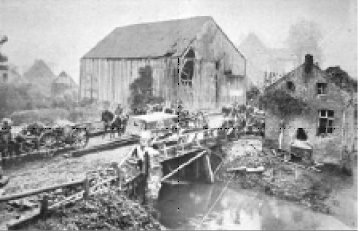
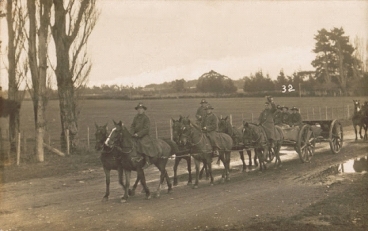
NZ Artillery on the move transporting their guns.
Location and date unknown. Thanks to Dave Reddiex
Once again they were on the move pushing the enemy back - it was now their turn to retreat. By September the Germans had fallen back to the Hindenburg Line but had now dug in their heels. September 11th saw the guns of the 2nd Brigade being brought forward covering the whole divisional front on the openiong barrage line. At times the 2nd Brigade was acting advance guard artillery.
By mid-September the 2nd Brigade was ordered to another Corp. The Brigade succeeded in withdrawing their guns fromn the line despite heavy fire and suffered no casualties. They marched south west of the NZ Division to join V Corps where they came under heavy fire. On September 21st they had orders to move north again when they were to be attached to the 40th Divisional Artillery. Their role once again was a supportive one, which saw them bringing the guns up ready for the planned attack on 27th September.
However, Herbert’s records show that he went on 3½ weeks leave in the UK on 26th September.
According to his records this was the only major leave he was granted during his time at the front other than the occassional return to the back of the lines when the battery was relieved by another and they were sent to a rest area for r & r. One must remember that he also had a pair of horses to care for during the engagements in battle. Looking after oneself was hard enough, to be caring for two other creatures what were working very hard under extreme conditions was another. He would have been exhausted on his arrival in England.
He returned from leave on the 20th October to rejoin his Brigade which was by now reunited with the other NZ Artillery Brigades and the NZ Division.
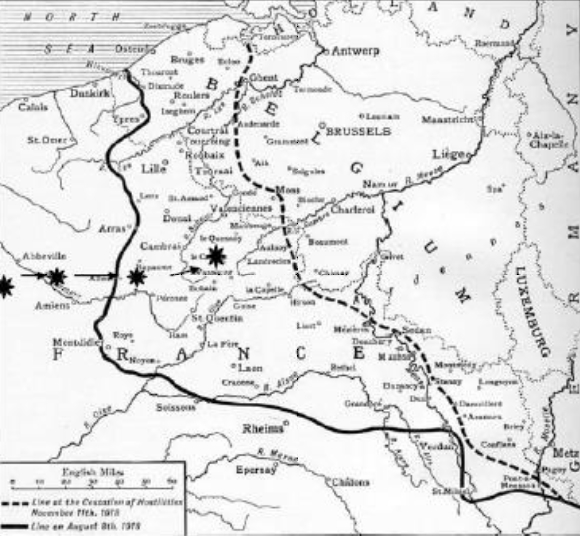
Cambrai had been taken and they were now well east of the town and were preparing to take Le Quesnoy in a wooded area where German strongholds were still very active. As the town was still occupied by civilians it was decided to avaid at all costs any direct hits on them. This passage from the History of the New Zealand Artillery sums up how the final battle began and Herbert’s part in it:“A section of 4.5in Howitzers from the 1st Brigade and a section of 18-prs from each of the 2nd and 3rd Brigades, were detailed for independent work in close co-operation with the infantry. These sections were to be responsible for engaging hostile tanks as well as movement, and in addition every battery was to be prepared to run one gun forward to engage the enemy tanks over open sights. By the night of November 3rd all guns were…… in their positions for the attack.
This was the last occasion on which the New Zealand Artillery paved the way for the advance of their infantry in a major operation, and from the complicated nature of the barrage and the masterly precision with which it advanced through all its stages, it may be regarded as a fitting climax to the work of the guns in supporting the infantry in attack. It was known that there were a large number of civilians in Le Quesnoy. It was therefore decided that the barrage should sweep the ramparts garrisoned by the enemy, and as it moved forward, completely encircle the town, but that no fire should fall within the limits of the town itself. This called for accurate calculation and planning in preparing the barrage table, and for extreme accuracy of fire at the guns. From its opening line at zero hour the barrage
Advanced in even lifts until it swept on to the western ramparts of the town. It then divided and continued eastwards, encircling the town as it went, and deluging the ramparts on the north and south with shrapnel and smoke shell, in order to protect the advance of the infantry on each flank. Having arrived on the eastern outskirts of the town it advanced again in a straight unbroken line, until it had reached a depth of six thousand yards from the starting point.
Frontline at the end of hostilities, 1919 [suns = Herbert’s Battery]
The morning of November 4th dawned fine, but visibility was lessened by a mist which rose up from the ground after sunrise. Zero hour was 5.30 am and the barrage came down promptly and with practiced precision. The enemy’s fire was comparatively feeble, but a good deal of hostile fire fell on battery areas……At 9.30 am a reconnoitring party from the 2nd Brigade, consisting of the Brigade and Battery Commanders, moved forward and crossed the railway line about a mile north-west of Le Quesnoy, but was then held up by machine gun fire from the ramparts………Reconnaissance parties went forward from the 1st and 3rd Brigades very shortly after the batteries of the 2nd Brigade had commenced to move.
By the afternoon the infantry had reached Beaudignes. Pressing determinedly on they crossed the road that skirted the western edge of the Forest de Mormal, and entered the tangled undergrowth of the forest itself. BY midnight they had penetrated deep into its heart. Le Quesnoy was not entered by the New Zealanders until the afternoon. The garrison at first refused to surrender, and ignored messages from the allies…… In the afternoon an officer of the division accompanies by a captured German officer, attempted to enter the town to explain the situation to the garrison, but they were fired on from the ramparts. Later in the day the garrison surrendered, and the New Zealanders entered the town to the wild delight of the civilian inhabitants…..
Persistent rain fell on November 5th rendering doubly difficult the advance through the dense and tangled undergrowth of the forest……. The 2nd Brigade moved up through Beaudignes and along the western edge of the forest….. The road along the western edge of the forest was in very bad condition which was rapidly being made worse by the heavy rain…..
On the following morning, November 6th, certain batteries fired a barrage in support of an attack by the 4th Division, which was to make an effort to advance from the eastern edge of the forest. The attack however, was not successful. The 2nd Brigade, which was advanced guard artillery for the day, had its teams at the gun positions, ready for a move at 7 am but a reconnaissance showed that the roads through the forest were quite impassable…… blown up bridges made the roads of little use to wheeled transport….. Until the bridges were erected it was almost an impossibility for the guns to cross the forest in which few, if any, positions could be found for batteries; but it was imperative that the guns should go forward. A section of the 6th (Howitzer) Battery also got into action a little further to the north. About midday an attempt was made to get the remaining guns of the 6th Battery across the temporary bridge which had been constructed. IT was a risky business; but the guns and vehicles were got safely over with the loss of one wagon which went over the side into the stream, rendering the bridge unsafe for further traffic. As a demand had been made for some howitzers and 18-prs to support a small operation by the 42nd Division, a section of the 5th Battery was sent forward over the forest track, the 9th Battery following the route taken by the advanced section of the 6th Battery, and going into action in the same locality.
Rain was still falling on November 7th and conditions on the roads and tracks became steadily worse. The day was quiet, the enemy offering little opposition to the advance of the 42nd Division which attacked at 8.45 am under cover of a barrage fired by the 2nd Brigade. The 1st Brigade moved forward during the afternoon to the south of Hargnies and Vieux-Mesnil and the 2nd Brigade became reserve brigade.”
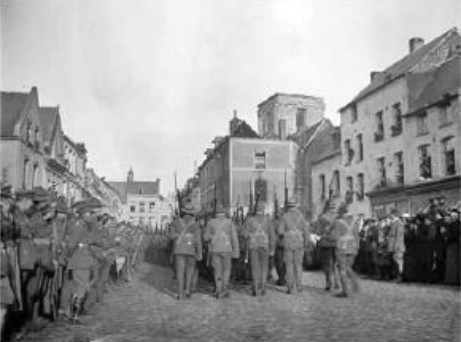
New Zealanders march through Le Quesnoy on 10th November 1918
This in effect was the last time Herbert was in action because on November 9th the order was given for all batteries to return to the NZ Division at Quievy, north of Le Quesnoy and on November 11th the war ceased.
On November 28th the whole New Zealand Division which formed a part of the Army of Occupation, set off for the long trek to Germany. Thankful Belgian civilians gave them a hero’s welcome and after nearly a month on the trek the NZ Division arrived near Cologne on Christmas Day, 1919. The weather was cold and “somewhat cheerless”. The next day they marched into Cologne. Despite the deprivations of war the citizenry were pleased that it was over and they still knew who to enjoy themselves. For Herbert and his comrades, although they still had ordinary routines to fulfil, it was an opportunity to enjoy some light hearted entertainment even if it was German.
He may even have taken the opportunity and attended the most popular “Opernhaus” where for a modest charge one could see and hear a high standard of opera performance.
Demobilisation began on January 1st, 1919. From Cologne they were trained back to Étaples- a two day journey in bitter cold winter weather – the earlier recruits leaving first. Herbert proceeded to the UK via Étaples on January 7th and from there to Larkhill Camp [1] near Stonehenge in Wiltshire. It was to be another six months before Herbert would return to New Zealand.
[1] Source: The Royal School of Artillery
Troop ship SS Mamari
On July 3rd 1919 Herbert embarked at London on the SS Mamari for New Zealand arriving back in NZ on August 20th. When Herbert was finally discharged in September 1919 he was nearly 28 years old and he had served in France and Belgium for 2 years and 117 days.
To sum up – Herbert had seen almost continuous action - having arrived on the Western Front on the coast of Belgium then set to the Ypres Salient when the Allies had to hold the line. He caught the end of the Second Battle of Passchendaele, was involved in the serious retreat from the Messines. He was then involved in the Battles of Lys and the Third Somme; the offensive against the Germans followed by the last months of the war in final battle at Le Quesnoy.
From all accounts Herbert was one of the lucky ones. He had not suffered a physical injury, although having been through such intense action, almost without relief from the time he joined the 6th Battery on 10th November 1917 to the Armistice Day on November 11th.
Herbert’s tumultuous was had finally concluded and he returned to “Grove Hill”, his family and the peace and quiet of New Zealand. War weary perhaps, Herbert’s first few days back in NZ were spent with his parents at Devonport (where they had retired) His brother Harold, with whom he shared a close bond would have been relieved to see him home as well. He did not speak much about his war experiences, but let it slip once that he had a horse shot from under him.Herbert and Dorothy were divorced in 1928.
This article is an extract from “The Hey Family History” by Katherine O’Regan JP QSO, Te Awamutu, New Zealand
Page last updated
28 May 2014